
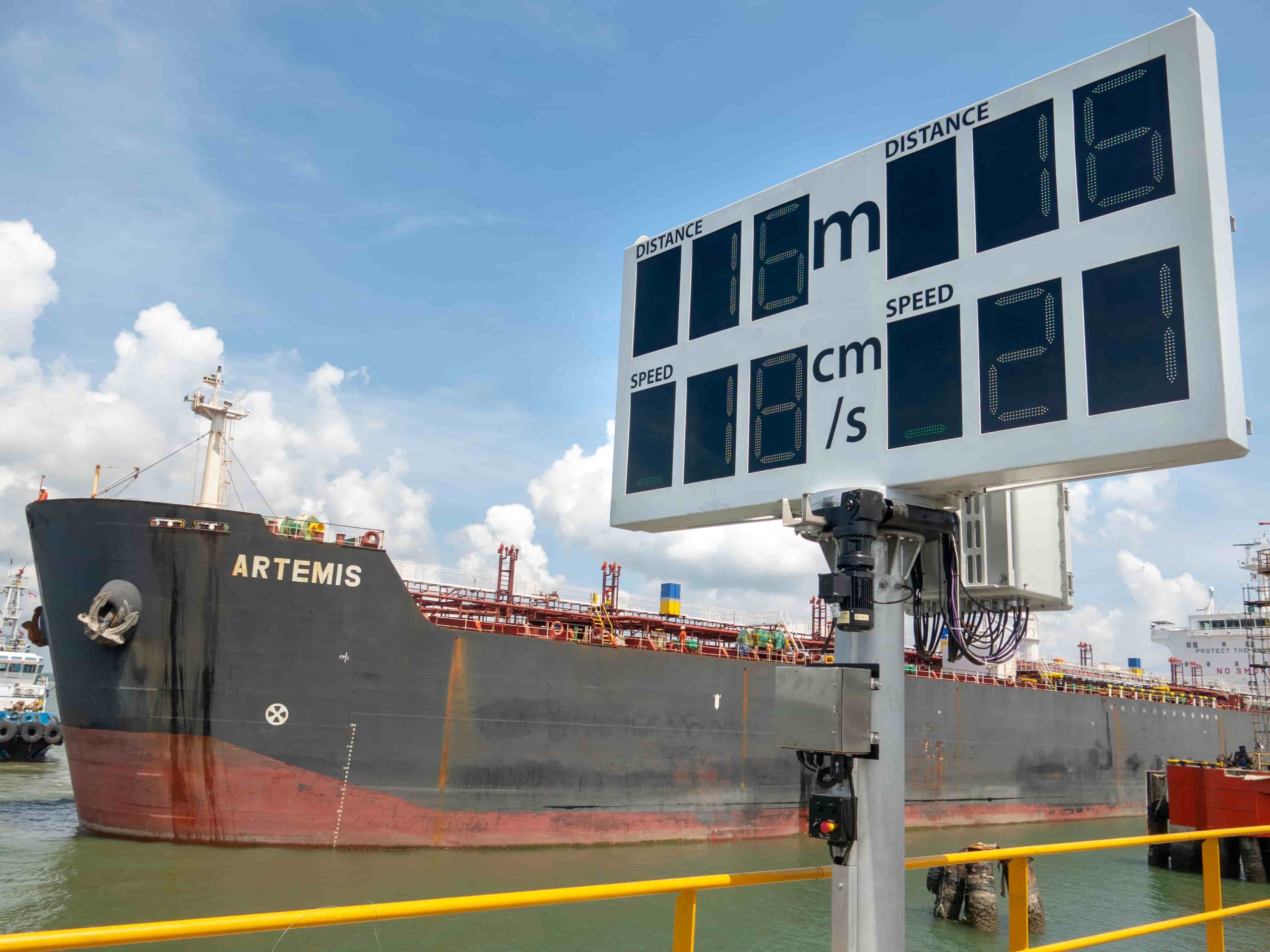
A berthing aid system is a solution installed on the jetty that measures and displays critical vessel approach data, such as distance, speed, angle and position, to assist a safer and more controlled berthing maneuver.
The system monitors in real time the position and movement of the vessel during the final berthing phase, measuring critical parameters such as distance to the dock, approach speed, berthing angle and bow and stern position.
SETI provides berthing aid systems for hydrocarbon, LNG, gas, chemical, bulk and port terminals, supporting technical specification, supply, installation, commissioning and after-sales support according to the operating conditions of the jetty.
Berthing aid systems are used in oil terminals, chemical terminals, LNG terminals, gas terminals, bulk terminals, industrial ports, container terminals, offshore jetties and docks where the safety of the approach maneuver is critical.
They are especially useful in operations with large vessels, limited visibility, variable environmental conditions, high traffic density, sensitive fenders, approach speed restrictions or the need to record data for later analysis.
The system helps reduce the risk of damage to vessels, fenders and jetty structures, providing clear and reliable information for a safer, more controlled and traceable berthing maneuver.
The system uses laser sensors installed on the jetty to continuously measure the distance between the vessel hull and the jetty structure.
The data is processed in real time and displayed to operational personnel through high-visibility LED displays, control room screens, remote interfaces or handheld devices, depending on the selected configuration.
This allows the pilot, crew and terminal operators to follow the maneuver closely, control the approach speed and respond quickly when conditions change.
Contact us for an initial project review and selection of the appropriate configuration.
A berthing aid system can measure and display the main parameters that influence a safe maneuver, including:
LED displays installed on the jetty make it possible to show clear and visible information during the approach maneuver.
They can indicate distance to the jetty, approach speed, berthing angle, speed alarms and other data relevant to the operation.
The information can be viewed from the jetty, the control room or remote devices, allowing different authorized users to access consistent data during the maneuver.
Each berthing aid system must be configured according to the jetty layout, vessel type, fender location, required visibility, control architecture and operating conditions of the terminal.
The system can be integrated with LED displays, PCs, PLCs, control room, remote interfaces, wireless devices, alarm systems and existing supervision platforms.
It can also be complemented with environmental monitoring systems to incorporate wind, wave, tide, current and other relevant data for maneuver safety.
The berthing aid system is part of the set of critical equipment of an industrial jetty.
It can be conceptually integrated with Marine loading arms, gangway access systems for vessels, quick release mooring hooks, ship-to-shore link, environmental monitoring systems and terminal operating procedures.
Correct specification makes it possible to improve coordination between the berthing maneuver, mooring, safe access to the vessel, product loading or unloading and communication with the vessel.
The berthing aid system can be complemented with an environmental monitoring system to provide real-time information on meteorological and oceanographic conditions.
The data may include wind speed and direction, wave height, tide, current and other parameters defined according to the project.
This information helps pilots and operators make better decisions during approach, berthing, vessel stay at the jetty and departure from the terminal.
In oil, chemical, gas or LNG terminals, berthing aid systems can be specified with components suitable for classified areas when the project conditions require it.
The selection of sensors, displays, panels, alarms, electrical equipment and accessories must be carried out considering the area classification, the product handled, the applicable regulations and the terminal’s safety philosophy.
The objective is to ensure reliable operation in marine, industrial and potentially explosive environments, without compromising personnel safety or system availability.
In addition to assisting during the maneuver in real time, the system can record historical berthing data for later analysis.
This information can be used to review maneuvers, identify events, analyze approach speeds, verify alarms, improve operating procedures and support internal investigations in the event of incidents.
Data logging makes it possible to convert each maneuver into useful information to improve safety, training and operational traceability at the terminal.
A berthing aid system makes it possible to improve the safety of port maneuvers, reduce impact risks, limit damage to fenders, jetties and vessels, and improve decision-making during approach.
It also makes it possible to record operational information, generate reports, analyze previous maneuvers and improve the terminal’s berthing procedures.
By integrating real-time measurement, alarms, clear visualization and environmental data, the system contributes to a safer, more controlled and traceable operation.
A berthing aid system is a solution installed on the jetty that measures and displays critical vessel approach data, such as distance, speed, angle and position, to assist a safer and more controlled berthing maneuver.
Yes. Berthing Aid System and Docking Aid System are used to describe systems that assist safe vessel berthing through measurement, visualization and monitoring of critical parameters during approach.
It is used to support the pilot, crew and terminal personnel during the vessel approach to the jetty, reducing impact risks, fender damage and errors during the maneuver.
It can display distance to the jetty, approach speed, bow and stern position, berthing angle, drift, fender compression and environmental data such as wind, waves, tides or currents.
It can include laser sensors, LED displays, traffic lights, audible and visual alarms, remote interfaces, handheld devices, visualization software, data logging and environmental sensors.
Yes. The system can be configured with visual or audible alarms when defined limits for speed, distance, angle, drift or fender compression are exceeded.
Yes. The system can be complemented with monitoring of wind, waves, tide, current and other environmental variables to improve decision-making during the maneuver.
Yes. Berthing aid systems can be specified for oil, chemical, gas and LNG terminals, considering the area classification, product handled and project safety requirements.
Data such as vessel type, jetty layout, fenders, maximum approach speeds, environmental conditions, required visibility, alarms, historical record requirements and integration with other systems are required.
 EN
EN  ES
ES  FR
FR