Gangway access systems for vessels are systems designed to allow safe personnel access between the jetty and the deck of a vessel, barge or craft during port, oil, chemical or industrial operations.
This equipment compensates for height differences, vessel movements, tides, loading and unloading, and variable operating conditions, reducing risks for operators, crews and maintenance personnel.
SETI provides gangway access systems for vessels for hydrocarbon, LNG, gas, chemical and port terminals, supporting technical specification, supply, installation and after-sales support according to the operating conditions and the type of vessel.
Gangway access systems for vessels can be configured according to deck height, vessel movement range, tides, available space on the jetty, type of vessel and the terminal’s safety requirements.
The most common configurations for port and industrial terminals include column type gangways, tower type gangways, riding ladders, systems for barges and solutions with integrated accessories such as hydraulic cranes, control cabins, lighting, alarms or support for fire monitors.
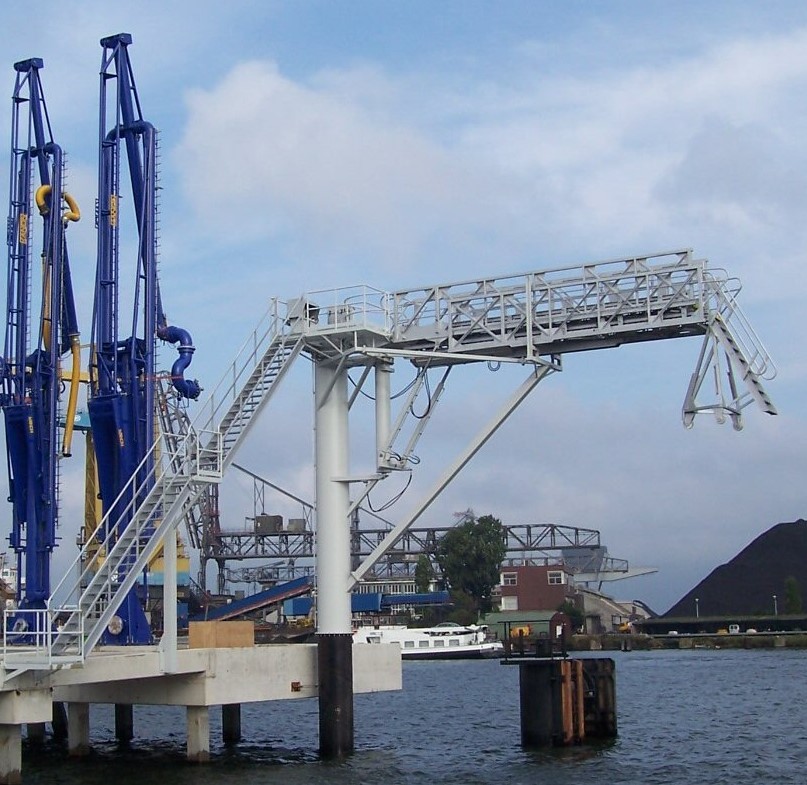
The column type gangway uses a fixed structure with a rotating platform located at a defined height. A telescopic gangway is installed on this platform and, once positioned on the vessel deck, it can follow the movements of the vessel within its design range.
This configuration is suitable for terminals with defined height ranges and where a robust, compact solution with limited occupation of space on the jetty is required.
It can incorporate accessories such as a service crane, lighting, alarms, control cabin, support for a fire monitor and other elements according to the project requirements.
The tower type gangway incorporates a telescopic gangway that moves vertically along a tower type structure by means of a lifting platform.
This configuration makes it possible to cover a wide range of deck heights, from small barges to large tankers, compensating for variations caused by tides, loading, unloading, drift and vessel movements.
The tower type gangway is especially suitable when maximum operational flexibility, multiple vessel types or large variations between jetty level and vessel deck are required.
The access ladder, also known as a riding ladder, can be used when the height variation between the jetty and the vessel deck is limited and sufficient space is available at the terminal.
It can be configured as a manual, hydraulic or electric system, according to the required level of automation, operating conditions and frequency of use.
Compared with tower or column type solutions, it is usually a simpler and more economical alternative, although it requires careful evaluation of the available space, operating envelope and safety conditions.
Complete our technical form or contact us by WhatsApp for an initial project review.
For barges, inland waterway vessels, coasters, bunkering vessels, small scale LNG vessels and other smaller vessels, specific access solutions can be used, selected according to the height range, frequency of operation, and available space.
These gangways can be configured with self-leveling anti-slip steps, fixed steps or a flat walking surface, and can be operated by manual, hydraulic or electric actuation according to the needs of the project.
When the classified area requires it, the system can also be specified with electrical components suitable for environments with risk of explosive atmospheres.
In hydrocarbon, chemical, gas or LNG terminals, gangway access systems can be specified with components suitable for classified areas when the project conditions require it.
The selection of electrical equipment, lighting systems, alarms, sensors and accessories must be carried out considering the area classification, the product handled, the applicable regulations and the terminal’s safety criteria.
Gangway access systems for vessels are part of the operating and safety system of an industrial jetty.
They can be conceptually integrated with Marine loading arms, quick release mooring hooks, berthing aid systems, ship-to-shore link, environmental monitoring systems and terminal operating procedures.
Correct specification makes it possible to improve terminal safety, emergency response and coordination between loading, unloading, access and communication operations with the vessel.
On longer gangways, the weight of the equipment can make manual maneuvering difficult and increase risks for personnel.
Assistance solutions using counterweights are available, allowing the gangway to be maneuvered and lifted with less effort, reducing the need for lifting equipment and improving operational safety during positioning on the vessel deck.
This type of solution can be evaluated both for new gangways and for certain existing equipment, according to the configuration, length and operating conditions of the system.
Gangway access systems for vessels make it possible to improve personnel safety, reduce the risk of falls, facilitate access during loading and unloading operations, and adapt the operation to different types of vessels.
Their robust and proven design makes it possible to obtain a long service life, low maintenance and high operational reliability in demanding marine and industrial environments.
Gangway access systems for vessels are systems that allow safe personnel access between the jetty and the deck of a vessel, barge or craft during port and industrial operations.
They are used to facilitate safe access for operators, crews and maintenance personnel during loading, unloading, inspection or service operations on industrial, oil, chemical and LNG jetties.
The most common configurations are tower type gangways, column type gangways, riding ladders, gangways for barges and access systems adapted to specific operating conditions.
A telescopic gangway makes it possible to adapt the length and position of the access according to the deck position, vessel movement, tides and loading or unloading conditions, improving safety and operational flexibility.
Yes. Gangway access systems can be specified with components suitable for classified areas when installed in environments with risk of explosive atmospheres, according to the project requirements.
Data such as jetty height, minimum and maximum deck levels, vessel types, tidal variation, expected movements, available space, area classification, environmental conditions and operational requirements are required.
 EN
EN  ES
ES  FR
FR