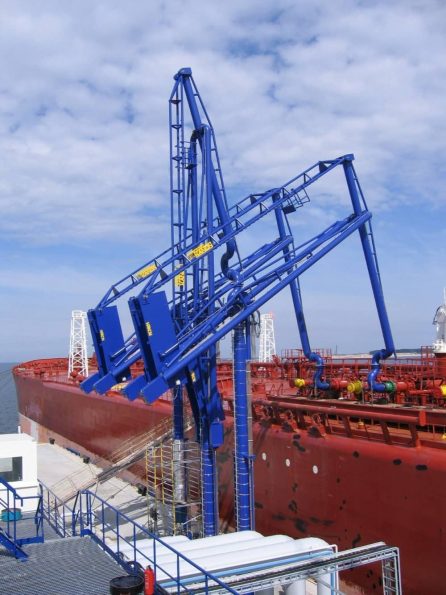
Marine loading arms are articulated equipment used to transfer oil, chemicals, LPG, LNG and other fluids between a tanker, barge or LNG carrier and a port terminal.
They make it possible to carry out loading and unloading operations with greater safety, better operational control and lower spill risk than conventional hoses, especially in oil, chemical, gas and LNG terminals.
SETI supports operators, engineering companies, EPCs and industrial clients in the specification, supply, installation, commissioning and after-sales support of marine loading arms for industrial jetties and hydrocarbon terminals.
Our marine loading arms feature a symmetrical design. Special attention has been paid to the rotation axes of the pantograph bar, both in the design and in the material selection, thereby ensuring smooth operation with minimal maintenance.
Our simple counterweight balancing system makes maneuvering the arms both manually and hydraulically safe and easy, saving time and labor.
Our marine loading arms require minimal maintenance, and all arm seals can be replaced without scaffolding or dismantling the loading arm.
Our loading arms are manufactured to the latest OCIMF requirements and to the standards of the major oil companies.
See also other products related to Jetties: quick release mooring hooks, gangway access systems, berthing aid systems, and ship-to-shore link.
Complete our technical form or contact us by WhatsApp for an initial project review.
Marine loading arms are used on jetties and port terminals for the loading and unloading of liquid and gaseous products, including crude oil, fuels, chemicals, LPG, LNG and other industrial fluids.
They can operate with tankers, barges, LNG carriers and different manifold configurations, depending on the product, the required flow rate, the operating envelope, the environmental conditions and the applicable standards.
The ERC provides a safe, spill-free and fully automatic disconnection of the loading arm from the vessel when it exceeds the safe working envelope for which the arm has been designed.
An ERC basically consists of two ball valves placed as close together as possible. The flanges of the two valves are joined by clamps that allow the two valves to be physically separated.
After the ball valves are closed, one closes the loading arm and the other closes the manifold, the latter remaining mounted on the vessel during disconnection.
The hydraulic Quick Connect/Disconnect Coupler (QC/DC) allows the operator to connect the loading arm to the manifold remotely, by pressing a button. Benefits:
Above all, the coupler has a simple and robust design. The claws are very robust and do not require regular maintenance. Hydraulic Quick Connect/Disconnect QC/DC Couplers can replace the hydraulic couplers already installed on the marine loading arm, thus facilitating connections and reducing maintenance cost to a minimum.
SETI participates in LNG solutions, including marine loading arms for LNG, bunkering applications and specific configurations for cryogenic transfer, according to the operating conditions, flow rate, temperature, expected vessels and project safety requirements.
Marine loading arms are articulated equipment used to transfer hydrocarbons, chemicals, LPG, LNG and other fluids between a vessel or barge and a port terminal.
They are used for loading and unloading operations on oil jetties, chemical terminals, LNG terminals, gas plants and other industrial port facilities.
They offer greater operational safety, better connection control, less effort for the operator, lower spill risk and a more stable operation during product transfer.
An ERC, or Emergency Release Coupler, is an emergency disconnection system that allows the arm to be safely separated from the vessel’s manifold when the defined operating envelope is exceeded.
A QC/DC, or Quick Connect/Disconnect Coupler, is a quick coupling that allows the loading arm to be connected to or disconnected from the vessel’s manifold more quickly, safely and in a controlled manner.
Yes. SETI participates in LNG solutions, including marine loading arms for LNG and bunkering applications, according to the operating conditions and project requirements.
 EN
EN  ES
ES  FR
FR