Truck and railcar loading arms are articulated equipment used to transfer liquid or gaseous products between a fixed facility and a tank truck, railcar, ISO container or other mobile vessel.
They make it possible to carry out loading and unloading operations in a safer, more ergonomic and more controlled way than flexible hoses, reducing operator effort, leakage risks, exposure to vapors and operating times.
SETI provides top loading arms, bottom loading arms and associated safety equipment for hydrocarbon terminals, chemical products, fuels, LPG, ammonia, asphalt, bitumen and other industrial products.
This equipment is used in fuel terminals, chemical plants, refineries, industrial plants, rail operations and loading or unloading points for tank trucks and railcars.
They can be applied in top loading, bottom loading, open loading, closed loading, transfer of volatile products, corrosive fluids, viscous products, high-temperature fluids or special applications.
Correct equipment selection makes it possible to improve operational safety, reduce emissions, limit spills, protect the operator and adapt the solution to the product, vehicle and real conditions of the facility.
Truck and railcar loading arms can be configured as top loading arms or bottom loading arms, depending on the type of operation, vehicle, product and facility conditions.
Top loading arms are used to load or unload tank trucks, railcars, ISO containers or other vessels from the top. They can incorporate drop tubes, balancing systems, heating, thermal insulation or special materials for corrosive, viscous or high-temperature products.
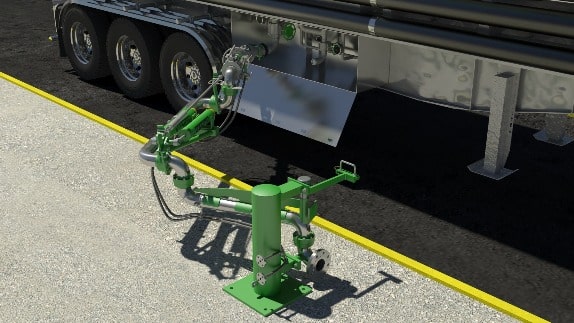
Bottom loading arms allow connection from the bottom or side of the truck or railcar, facilitating a safer operation from floor level, reducing operator exposure to vapors and improving integration with vapor recovery systems.
In both cases, the configuration must be defined according to flow rate, temperature, pressure, chemical compatibility, area classification, available space, presence of canopy or weighbridge, and the safety requirements of each terminal.
Contact us for an initial technical and commercial review of your loading or unloading operation.
In addition to loading arms, truck and railcar operations may require associated safety equipment to reduce risks during product transfer.
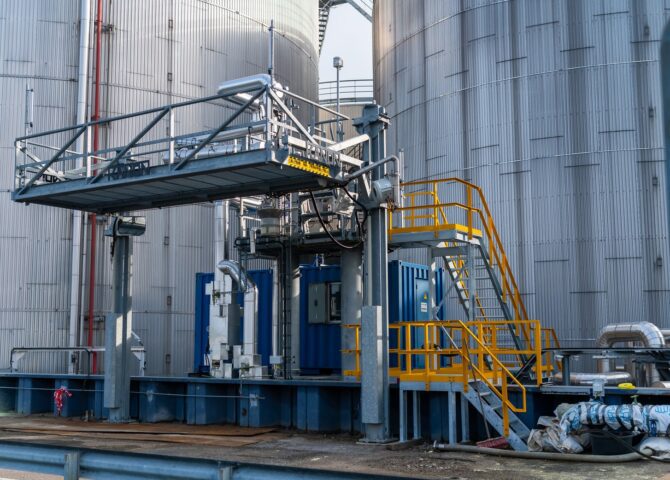
This equipment may include safe access systems for top loading, platforms, folding stairs, safety cages, fall protection, sensors, interlocks, overfill protection, grounding, emergency stop buttons, breakaway couplings and specific accessories depending on the project.
The selection of safety equipment must be carried out considering the product handled, area classification, type of loading, level of operator exposure, frequency of operation and the terminal’s internal procedures.
Truck and railcar loading arms can be used with a wide variety of liquid and gaseous products, including fuels, hydrocarbons, chemical products, solvents, acids, liquid fertilizers, LPG, ammonia, asphalt, bitumen, oils and other industrial fluids.
Each application requires reviewing chemical compatibility, operating temperature, viscosity, pressure, flow rate, seals, materials, connection type and safety requirements.
For corrosive, toxic, flammable, viscous or high-temperature products, special materials, internal linings, closed systems, heating, thermal insulation or specific accessories can be evaluated.
To correctly define a truck or railcar loading solution, it is necessary to review the operating, product and safety conditions.
The main data include:
Each loading operation has specific conditions. The configuration must be defined according to the product, flow rate, temperature, pressure, viscosity, type of vehicle, connection height, presence of canopy, truck weighbridge, available space, area classification and safety requirements.
For this reason, loading arms and safety equipment should not be selected only as standard products, but as part of a solution adapted to the facility.
SETI can support the technical definition of solutions for top loading, bottom loading, corrosive products, flammable products, viscous fluids, high temperatures, volatile products, LPG, ammonia, fuels and chemical products.
In operations with volatile products, loading arms can be integrated with vapor recovery systems to reduce VOC emissions, odors, product losses and operator exposure.
Vapor recovery makes it possible to capture vapors generated during loading and conduct them to a vapor recovery unit or another treatment system defined by the facility.
The integration between the loading arm, vapor connection, couplings, safety systems and recovery unit must be defined from the technical specification stage.
In hydrocarbon, chemical or fuel terminals, equipment must be specified considering operator safety, exposure to vapors, spill risk, static electricity, overfilling and compatibility with emergency systems.
The selection of materials, gaskets, seals, couplings, balancing systems and accessories must be carried out considering the product handled, the applicable regulations and the facility’s safety philosophy.
When the project requires it, equipment can be specified with components suitable for classified areas or environments with risk of explosive atmospheres.
Truck loading arms are articulated equipment used to transfer liquid or gaseous products between a fixed facility and a tank truck, railcar, ISO container or other mobile vessel.
Top loading allows loading from the top of the tank. Bottom loading connects from the bottom or side of the truck or railcar, generally with greater operational safety and better vapor control.
It may include platforms, folding stairs, safety cages, fall protection systems, grounding, overfill protection, interlocks, sensors, breakaway couplings and emergency stop buttons.
They can be used for fuels, hydrocarbons, chemical products, solvents, acids, LNG, LPG, ammonia, liquid fertilizers, petrochemicals, asphalt, bitumen and other industrial fluids.
Yes. In operations with volatile products, loading arms can be integrated with vapor recovery systems to reduce VOC emissions, odors and product losses.
Yes. When the project requires it, components suitable for classified areas can be specified, considering the product handled, the area classification and the applicable safety requirements.
Data such as product, flow rate, temperature, pressure, viscosity, vehicle type, connection dimensions, canopy, weighbridge, area classification, materials, seals, accessories, vapor recovery and safe access needs are required.
 EN
EN  ES
ES  FR
FR