
The DAS, or Dissipation Array System®, is a lightning protection technology designed to reduce the probability of direct lightning strikes on critical structures.
Unlike traditional air termination systems, which seek to intercept lightning and conduct it to ground, DAS technology works on the principle of charge dissipation and ion transfer, with the objective of reducing the formation of upward leaders that may connect with a downward discharge.
SETI provides DAS systems for storage tanks, geodesic domes, hydrocarbon terminals, industrial plants, port facilities, metallic structures and critical assets exposed to electrical storms.
Traditional lightning protection systems, such as air terminals or conventional lightning rods, are designed to provide a controlled path to ground when a discharge occurs.
The approach of the DAS lightning protection system is different: it seeks to reduce the probability that the connection channel required for lightning to directly strike the protected structure will form.
For this reason, the DAS is considered a lightning avoidance technology, especially useful in facilities where a direct discharge may cause fires, equipment damage, operational shutdowns, risks to personnel or significant environmental consequences.
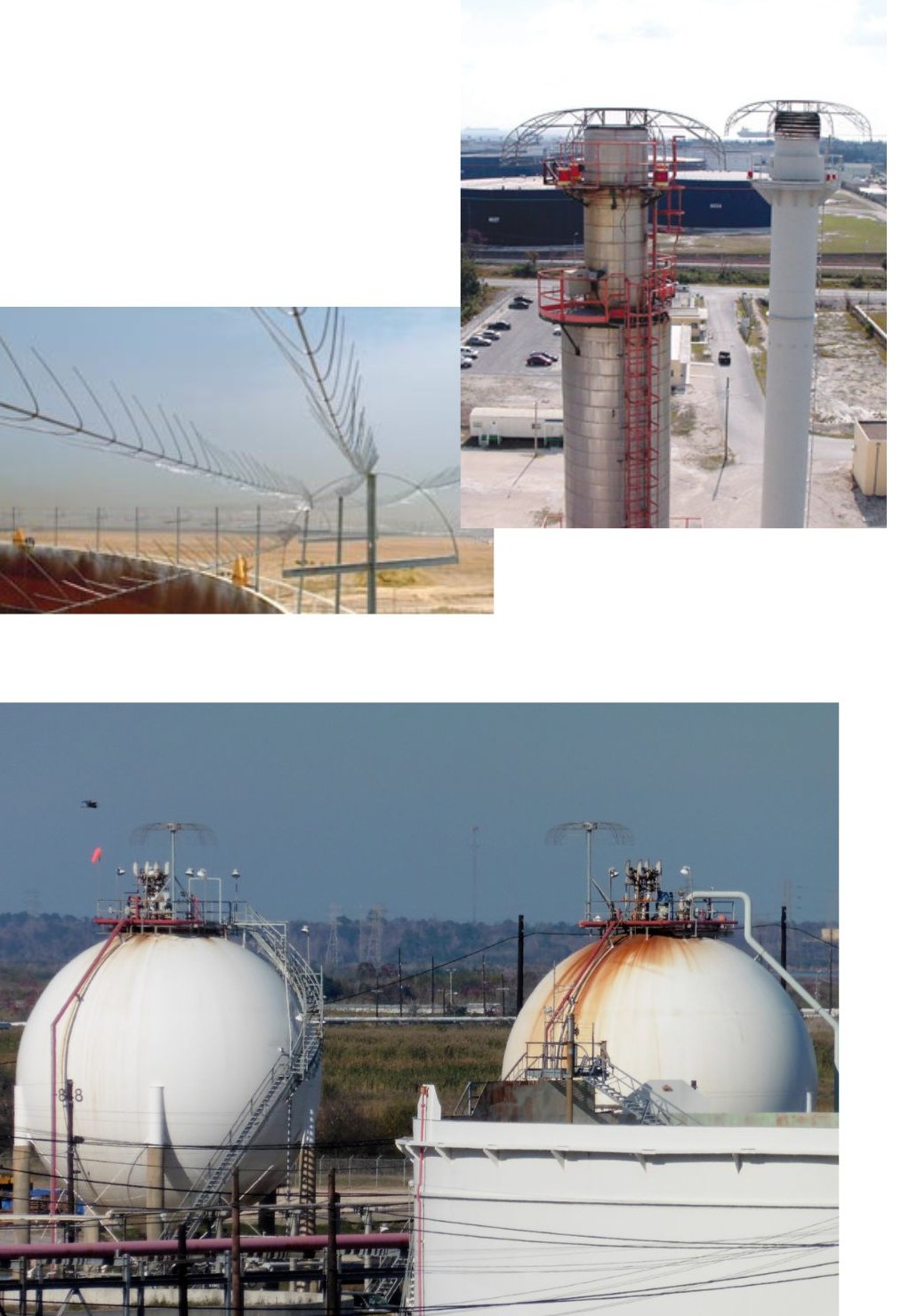
SETI supports the definition of DAS solutions for hydrocarbon terminals, storage tanks, industrial plants and port operations.
DAS systems can be applied to storage tanks, API tanks, tanks with geodesic domes, oil terminals, chemical terminals, gas plants, port facilities, refineries, industrial areas and critical structures.
In tanks containing hydrocarbons or flammable products, lightning protection is especially important due to the presence of vapors, metallic structures, electrical equipment, measurement systems, instruments, seals, floating roofs, domes and accessories installed on the tank.
The DAS can also be evaluated in terminals where several tanks are located close to each other, or where there are tall structures, racks, control buildings, sensitive equipment or operating areas that require an integrated strategy against lightning risk.
For a lightning discharge to occur, a connection must be established between downward leaders from the cloud and upward leaders that form from objects or structures on the ground.
The DAS system seeks to interfere with this process through multiple dissipation points connected to a low-impedance grounding system. These points promote gradual charge transfer to the atmosphere, reducing the intensity of the local electric field and making it more difficult for upward leaders to form from the protected structure.
The design must consider the geometry of the installation, height, protected area, orientation, existing equipment, site conditions, exposure level and characteristics of the structure.
Each DAS system must be designed according to the specific conditions of the site. It is not a standard piece of equipment installed in the same way on every project.
The protection calculation may consider variables such as elevation, area to be protected, orientation, number and distribution of dissipation points, geometry of the structure, location of tanks or domes, ground conditions and available grounding system.
In applicable configurations, the protection zone can be represented as a geometric volume associated with the height of the array, making it possible to evaluate which structures remain within the protected area. The final definition must be made by specialists, with site information, general drawings, tank dimensions and real installation conditions.
The effectiveness of a DAS lightning protection system depends not only on the equipment, but also on the design, installation, grounding, assembly, component tensioning, inspection and maintenance.
For this reason, installation must be carried out following specific technical instructions and, when the project requires it, with specialized supervision. Activities such as assembly, connection, tensioning, final inspection and warranty release must be performed in accordance with the manufacturer’s procedures and the project conditions.
SETI can support technical coordination, review of site information, request for drawings, interaction with specialists, supply of the system, installation supervision and after-sales support.
A DAS lightning protection system should not be analyzed in isolation. For more complete protection, it must be integrated with an overall lightning protection surge protection strategy.
This strategy may include a DAS system, low-impedance grounding, transient surge protection, equipotential bonding, review of conductive paths and protection of electrical equipment, instrumentation, signals and control systems.
In storage tanks, it can also be complemented with RGA systems for floating roofs, instrument protection, electrical continuity review and specific safety criteria for areas with hydrocarbons or flammable products.
The DAS can be applied to tanks with aluminum geodesic domes, fixed roof tanks or special configurations where the upper structure of the tank requires protection against lightning discharges.
In this type of application, the system must be adapted to the geometry of the dome, tank diameter, height, location of accessories, type of structure, grounding system and operating conditions.
An important advantage is that the system can be evaluated even when the dome is already installed. Depending on the design and site safety conditions, its installation can also be analyzed without significantly interfering with tank operation.
The DAS and the RGA perform different functions and can be complementary.
The DAS is oriented toward reducing the probability of direct lightning strikes on a structure or tank, acting on the formation of upward leaders and charge dissipation.
The RGA, on the other hand, is used on floating roof tanks to maintain a low-impedance electrical connection between the floating roof and the tank shell, reducing the risk of sustained electrical arcs during atmospheric events.
In storage tanks, a complete strategy may include DAS for external protection against direct discharges, RGA for floating roof bonding, proper grounding and surge protection.
When the DAS system is designed, installed, inspected and maintained in accordance with the manufacturer’s technical criteria, it may be associated with a No-Strike Warranty, subject to the applicable terms and conditions of the project. This warranty reflects the approach of DAS technology, oriented toward reducing the probability of direct lightning strikes on the protected structure. Its validity depends on correct engineering, supervised installation, an adequate grounding system, compliant documentation and any periodic inspections required to maintain coverage.
A DAS system, or Dissipation Array System, is a lightning protection technology designed to reduce the probability of direct lightning strikes on critical structures.
A conventional lightning rod seeks to intercept lightning and conduct it to ground. The DAS seeks to reduce the formation of upward leaders, decreasing the probability that lightning will directly strike the protected structure.
No. The concept of the DAS is not to attract lightning, but to reduce the conditions that favor the formation of a direct connection between the cloud and the protected structure.
It can be installed on storage tanks, geodesic domes, hydrocarbon terminals, industrial plants, metallic structures, critical buildings, towers, racks and other facilities exposed to electrical storms.
No. The DAS is oriented toward reducing the probability of direct lightning strikes. The RGA maintains a low-impedance electrical connection between the floating roof and the tank shell, reducing the risk of sustained electrical arcs.
Yes. Depending on the tank configuration, dome configuration and site conditions, the system can be evaluated for installation even with domes already installed, and in certain cases without significantly interfering with tank operation.
 EN
EN  ES
ES  FR
FR