
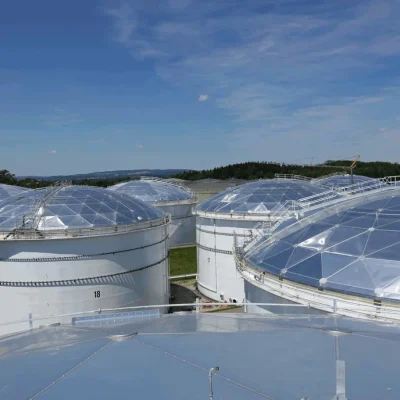
Aluminum geodesic dome roofs are self-supporting structures used to cover large-diameter storage tanks. They are primarily used at fuel terminals, refineries, petrochemical plants, chemical facilities and other industrial sites where protection of the stored product and reduced roof maintenance are important considerations.
Unlike a conventional carbon steel cone roof, a geodesic dome uses an aluminum space-frame structure made of triangulated structural members. This geometry allows loads to be transferred to the tank perimeter without requiring internal columns in many configurations.
The result is a lightweight, corrosion-resistant roof that is particularly well suited to both new tanks and retrofit projects involving existing storage tanks.
In hydrocarbon storage applications, geodesic dome roofs are frequently combined with internal floating roofs (IFRs), creating a system that protects the stored product from weather conditions while helping control evaporation losses and volatile organic compound (VOC) emissions.
Our geodesic dome roofs are specified according to the specific characteristics of the tank, the stored product, environmental loads, operating configuration and applicable project standards.
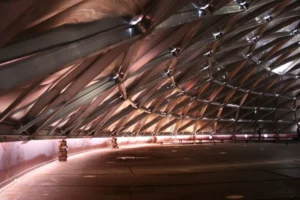
The structural efficiency of a geodesic dome comes from its geometry.
Instead of using large beams supported by internal columns, the structure is divided into numerous interconnected members forming a three-dimensional triangulated network. Loads applied to one area of the roof are distributed through this network to other structural members and ultimately transferred to support points located around the perimeter of the tank.
This configuration makes it possible to span large diameters with a relatively limited amount of material.
Aluminum is particularly well suited to this type of structure because of its combination of low weight, mechanical strength and natural corrosion resistance.
From a standards perspective, API 650, Appendix G, defines a structurally supported aluminum dome roof as a fully triangulated space-frame structure whose members are arranged approximately on a spherical surface and supported by the tank at points distributed around its perimeter.
A geodesic dome should therefore not be considered merely a lightweight cover. It is a structural system specifically engineered for each tank and for the loads applicable to its installation site..
Two tanks with the same diameter do not necessarily require the same dome design.
The design must consider the actual tank geometry and the project operating conditions. Key parameters typically include tank diameter, shell height, top configuration, wind and snow loads, seismic loads, operating loads, roof appurtenances, walkways, platforms, penetrations and, where applicable, loads associated with a suspended internal floating roof.
The way structural reactions from the dome are transferred to the existing tank must also be verified. In a retrofit project, this assessment is particularly important because the original tank shell may not have been designed to withstand the loads introduced by a new roof.
API 650 specifically requires the loads transmitted by this type of dome, as well as the details of its attachment to the tank, to be defined.
For this reason, specifying a geodesic dome roof should not be based solely on tank diameter.
One of the main differences compared with conventional roofs is the material itself.
Carbon steel requires protective coating systems to limit corrosion. Over the service life of the tank, this involves inspections, surface preparation, coating repairs and, in some cases, structural repair work.
Aluminum behaves differently. Its surface naturally develops a thin oxide layer that protects the material from atmospheric corrosion. As a result, an aluminum dome does not require the periodic corrosion-protection painting cycles typically associated with a carbon steel roof.
Key advantages of aluminum dome roofs include their low weight, corrosion resistance, ease of erection and long service life compared with conventional steel solutions.
This does not mean that a dome requires no inspection. Fasteners, seals, sealants, supports, penetrations and appurtenances should be included in the tank inspection program. However, a significant portion of the maintenance associated with corrosion protection and painting of a steel structure is eliminated.
The ability to cover a tank without internal columns is one of the primary reasons for using a geodesic dome roof.
On a conventional large-diameter fixed roof, columns may be required to support the structure. These columns occupy space inside the tank, create penetrations and interference points, and may complicate the installation and operation of an internal floating roof.
With a self-supporting dome, loads are transferred to the tank shell through peripheral supports.
This configuration simplifies the internal tank arrangement and is particularly advantageous when an aluminum internal floating roof is installed.
Eliminating columns reduces interference with the IFR, its peripheral seals and its vertical movement. It can also facilitate inspection and maintenance activities inside the tank.
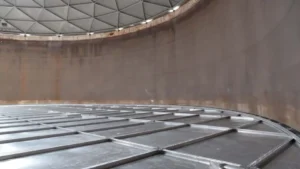
A geodesic dome roof and an internal floating roof perform different but complementary functions.
The dome serves as the tank’s external fixed roof. It protects the tank interior from rain, wind, dust and other environmental conditions.
La internal floating roof,, by contrast, floats on the surface of the stored product and follows changes in liquid level, significantly reducing the vapor space above the liquid.
The combination of a geodesic dome roof and an IFR is widely used for storage tanks containing volatile products.
Actual emissions performance depends on the stored product, IFR configuration, peripheral seal design, penetrations, operating conditions and applicable environmental regulations. It is therefore not appropriate to assign a universal emissions-reduction percentage to the dome alone.
SETI provides both geodesic dome roofs and various internal floating roof configurations in aluminum, stainless steel or hybrid designs, allowing the system to be selected according to the required service.
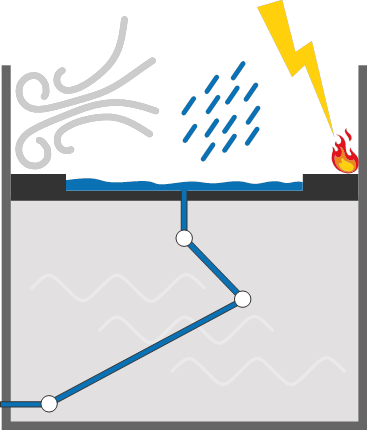
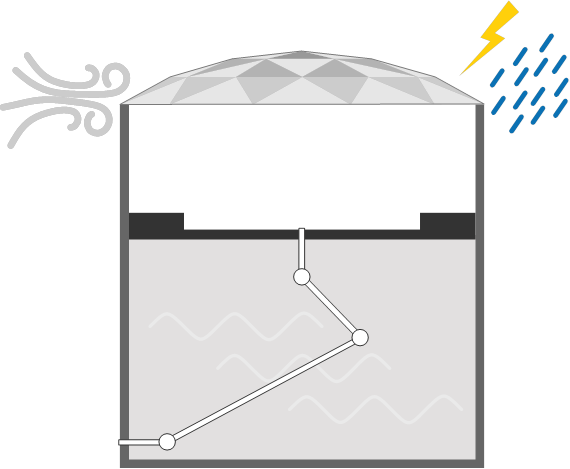
On open external floating roof tanks, rainwater must be removed through a drainage system installed on the floating roof itself.
Installing a geodesic dome prevents rainwater from falling directly onto the floating roof and allows water to drain externally over the surface of the dome.
In addition to rain, the dome protects the tank interior from dust, sand, snow and other external contaminants.
In coastal or industrial environments, the corrosion resistance of aluminum is also an important advantage over structures that depend on coating systems to maintain corrosion protection over several decades.
Wind is one of the environmental loads that must be considered in the structural design of a geodesic dome roof.
In addition, on open external floating roof tanks, wind acts directly on the upper portion of the tank and can influence evaporation losses.
By covering the tank, the dome physically separates the floating roof from the external environment and eliminates this direct exposure.
Actual emissions reduction, however, must be evaluated by considering the complete tank system rather than the presence of the dome alone. Floating roof configuration, seal effectiveness, stored product, temperature and operating conditions remain important factors.
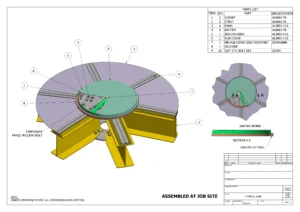
Although each manufacturer uses its own construction details, an aluminum geodesic dome roof for storage tanks includes several fundamental components.
The primary structure consists of extruded aluminum structural members forming the load-bearing network. Roof panels forming the exterior surface of the dome are attached to this structure.
The fastening bars, or batten bars secure the panels to the structure and form part of the weather-sealing system. Nodes are the points where several structural members converge and must provide both mechanical continuity and weather tightness.
Around the perimeter, the supports transfer dome loads to the tank. Depending on the design, these supports may allow certain movements caused by thermal expansion and structural deformation.
The system is completed by gaskets, sealants, bolting and project-specific appurtenances.
For domes supplied by SETI, particular attention is given to the structural configuration of members and supports, weather tightness, and the attachment of appurtenances and walkways to appropriate structural elements. Our domes are designed in accordance with the applicable requirements of API standards and Eurocodes. Walkways are attached to the dome’s load-bearing structure rather than simply to the panel fastening bars (batten bars).
The weather tightness of a geodesic dome roof does not depend solely on the aluminum panels.
Overall performance depends on how the connections between panels, structural members, nodes, batten bars, penetrations and peripheral supports are designed.
API 650 establishes specific requirements for the materials and construction of geodesic dome roof panels covered by Appendix G.
In hydrocarbon storage applications, it is also important to distinguish between a dome primarily intended to provide weather protection and a configuration in which the project requires a higher degree of vapor tightness.
The chemical compatibility of gaskets and sealing materials with the stored product must be verified during engineering.
Depending on the project, the dome may incorporate normal vents, emergency vents, skylights, manholes, gauge hatches, nozzles, platforms, walkways, fall-protection systems, instrumentation connections and supports associated with fire-protection systems.
Each of these items introduces penetrations or loads into the structure.
They should therefore preferably be defined during the dome engineering phase rather than added later in the field without verifying their structural impact and weather tightness.
There is no universal answer as to which roof type is the most economical for every project.
A carbon steel roof may offer a competitive initial cost. However, the comparison should consider the complete life cycle of the installation.
An aluminum dome eliminates much of the painting work associated with the roof, reduces the weight applied to the tank, avoids internal columns in many configurations, can simplify integration of an IFR and generally requires less hot work during installation.
On the other hand, initial investment, structural characteristics of the existing tank, erection logistics and project-specific requirements must be evaluated on a case-by-case basis.
It is therefore more relevant to evaluate CAPEX + installation + maintenance + downtime + service life, rather than comparing only the purchase price of the two roof types.
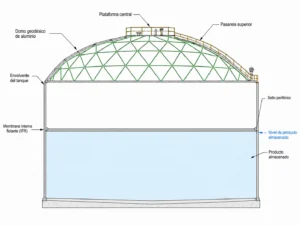
One particularly attractive application of aluminum geodesic dome roofs is the retrofit of existing storage tanks.
A tank originally equipped with an external floating roof may, depending on its structural condition and project objectives, be converted to a covered configuration.
The low weight of aluminum is an advantage in this type of project because it limits the additional loads transmitted to the tank shell and foundation.
Before defining the retrofit, however, the tank condition, geometry, roundness, structural capacity, upper wind girder, top configuration and any modifications made during its service life should be verified.
Dome engineering should be based on the tank’s actual geometry rather than solely on the original drawings.
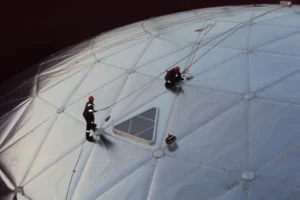
One practical advantage of the system is that a large portion of its components is prefabricated and delivered to the site ready for assembly.
This reduces the amount of field fabrication required on the tank and allows erection to be organized as a primarily mechanical assembly process.
Depending on available space, tank condition, dome diameter and available lifting equipment, different erection strategies may be considered.
The dome may be assembled inside the tank and then lifted into its final position. It may also be assembled at grade next to the tank and lifted into place with a crane, or progressively erected directly at the top of the tank shell.
The dome may be assembled inside the tank and then lifted into its final position. It may also be assembled at grade next to the tank and lifted into place with a crane, or progressively erected directly at the top of the tank shell.
Our aluminum geodesic dome roofs are designed for efficient and rapid installation.
A common specification mistake is to design the dome first and then add appurtenances without verifying the loads they introduce.
Walkways, platforms, piping, supports, fire-protection systems and certain components associated with the IFR can generate permanent, concentrated or dynamic loads.
These loads should be incorporated into the structural model from the beginning of the design process.
In particular, walkway attachments must transfer loads to appropriate structural members of the dome. Walkways on our domes are connected directly to the load-bearing structure and not solely to the panel fastening bars.
Lightning behavior should be addressed as part of the tank’s overall lightning protection, bonding and grounding assessment.
The fact that the dome is metallic does not mean that a tank equipped with a dome is automatically protected against all effects of a lightning discharge.
The tank configuration, type of floating roof, electrical connections between its various components, grounding system and applicable standards must be evaluated together.
Para instalaciones donde el análisis de riesgo requiera medidas específicas de protección contra descargas atmosféricas, SETI también ofrece el sistema DAS, que puede complementarse con el sistema RGA para asegurar la equipotencialidad entre una membrana interna flotante y la envolvente del tanque.
For API 650 storage tanks, Appendix G is a fundamental reference for structurally supported aluminum dome roofs.
The appendix establishes minimum requirements for the design, materials, fabrication and erection of this type of roof. It also defines how the dome must be structurally integrated with the tank and establishes specific requirements for various construction elements.
Our geodesic dome roofs are designed in accordance with the applicable requirements of API standards and Eurocodes.
API 650, however, does not replace project-specific requirements. Environmental loads, local codes, owner specifications and EPC engineering requirements must also be incorporated into the design.
For an initial technical evaluation, the following information should be available at a minimum:
Based on this information, a preliminary configuration can be developed and any additional data required to finalize the design can be identified.
You can complete our Geodesic Dome Roof Design Data Sheet.
An aluminum geodesic dome roof is particularly attractive when the operator wants to reduce corrosion- and painting-related maintenance, cover an external floating roof tank, retrofit an existing tank, eliminate internal columns, install an internal floating roof, or improve protection of the stored product from environmental conditions.
It may also be an attractive solution when the available outage window is limited or when the objective is to minimize field fabrication and welding.
The final decision should be based on a technical and economic assessment of the tank and its complete life cycle.
An aluminum geodesic dome roof is more than simply a lightweight alternative to a steel roof.
Its self-supporting geometry, corrosion resistance and ability to span large diameters without internal columns make it particularly suitable for modern storage tanks.
When combined with an internal floating roof, it can also form an integrated system designed to protect the stored product and control evaporation losses.
The key is to engineer the dome for the actual tank: geometry, loads, stored product, appurtenances, IFR, environmental conditions and erection constraints should all be defined before the structure is fabricated.
SETI supplies Aluminum geodesic dome roofs for new tanks and retrofit projects, providing support for technical selection, engineering, supply, installation supervision and project support.
The main standards used for aluminum dome roofs on storage tanks include API 650, Appendix G, and, within the European framework, EN 14015, Annex S. Structural design of the aluminum components may also incorporate the applicable requirements of EN 1999 (Eurocode 9). Environmental loads, reactions transmitted to the tank and project-specific conditions must also be considered.
Yes. Installing a geodesic dome roof on an existing tank is a common retrofit application. Before the solution is defined, the actual tank dimensions, condition and structural capacity of the shell, upper tank structure, existing appurtenances and reactions transmitted by the new dome to its support points should be verified.
At a minimum, the tank diameter and height, project location, design conditions, applicable wind, snow and seismic loads, stored product, tank top configuration and appurtenances to be incorporated into the dome should be known. For retrofit projects, the configuration and condition of the existing tank structure must also be evaluated.
An aluminum geodesic dome roof is a self-supporting triangulated space-frame structure that transfers loads to supports distributed around the tank perimeter. Its low weight and aluminum’s natural corrosion resistance make it possible to avoid heavy internal support structures and reduce periodic painting requirements. The choice between an aluminum dome and a conventional steel roof should be based on the specific characteristics of each tank and project.
The dome and the internal floating roof perform different functions. The dome serves as the external fixed roof and protects the tank interior from rain and wind. The internal floating roof remains on the surface of the stored product and reduces vapor space. Actual emissions reduction depends on factors including the stored product, floating roof design, peripheral seal, penetrations and operating conditions.
The final design of each installation must be carried out in accordance with the contractual specifications, project-specific conditions and current editions of the applicable standards.
These references provide a general technical framework. Their inclusion does not imply that all standards or all requirements apply identically to every tank or project.
Do you need to evaluate a geodesic dome roof for a new or existing storage tank? Complete our technical data sheet with the tank diameter, height, stored product, project location and design conditions. Based on this information, we can perform an initial technical evaluation and prepare a proposal for your project.
 EN
EN  ES
ES  FR
FR